
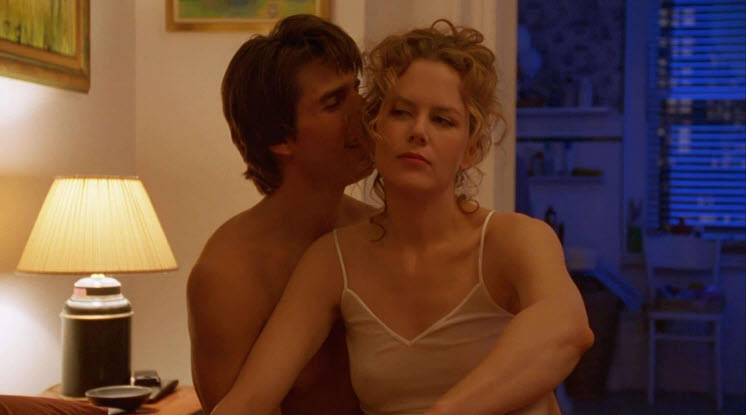
Stanley Kubrick’s last film “Eyes Wide Shut” is one naughty comedy of foreplay. Along the story, its plain ordinary hero is tempted by a series of tantalizing possibilities of sexual pleasure and transgression popping up here and there around him, but he always remains to stay in line somehow to our little amusement. Later in the story, these seductive opportunities are just gone beyond his reach, and he is quite baffled as wondering what exactly happened around him, while also coming to doubt his relationship with his wife who has her own sexual desire and discontent.
The opening part, which is memorably accompanied with Dmitri Shostakovich’s Waltz No. 2 from “Suite for Variety Stage Orchestra”, is more or less than a prelude to what Dr. William Bill Harford (Tom Cruise) and his wife Alice (Nicole Kidman) will go through during next few days of the Christmas season. Dr. Harford is a successful doctor residing in the West Central Park neighborhood of New York City along with his wife and their little daughter, and they happen to be invited to a big party held in the residence of one of his wealthy patients. Once they dress themselves up for the party, we soon see them greeted by Victor Ziegler (Sydney Pollack) and his wife, and the mood feels fairly good as they begin to enjoy the party together.
However, there comes a moment of seduction for both Dr. Harford and his wife when they happen to be separated for a while. While watching her husband casually talking with two young ladies, Alice is approached by some suave Hungarian gentlemen, and she finds herself slyly flirting with this dude as they courteously dance together during next several minutes – until she flatly reminds him again that she is married. Meanwhile, sandwiched by those two young ladies, Dr. Harford also receives a little naughty sexual suggestion just like his wife does from that Hungarian guy, but then, what a coincidence, the mood is interrupted by a sudden little emergency where he is needed right now.

On the next day, everything seems to be back to normal for Dr. Harford and his wife, but the mood becomes quite awkward at the following night when they become a little more honest to each other after smoking marijuana a bit in their bedroom. As talking about what happened at the party, they come to see more of how they do not know or understand each other that much, and the situation eventually becomes quite tense when Alice reveals how much she was once tempted to throw away everything just for one night of sexual pleasure with a total stranger.
Again, a little moment of pure coincidence comes right after that, and this begins Dr. Harford’s long night’s journey not so far from Leopold Bloom’s long day’s journey in James Joyce’s great novel “Ulysses”. Just like Bloom is often conscious of his wife Molly’s infidelity throughout his long journey in Dublin, Ireland, Dr. Harford cannot help but think about his wife’s possible infidelity as bouncing from one spot to another in Manhattan, and his current vulnerable state of mind becomes quite susceptible to a string of seductive opportunities coming along his way. For example, when he visits the residence of one of his patients who has just died, he tries to console the patient’s daughter as a good doctor, but, what do you know, she turns out to be quite emotionally vulnerable just like him, and he certainly feels tempted to cross the line along with her.
The situation takes a weird turn later when Dr. Harford drops by a nightclub where his old medical school friend, who now works as a freelancing pianist, currently works. This friend of his tells a bit about a rather strange private meeting held among some wealthy people, and Dr. Harford becomes quite willing to sneak into that clandestine meeting just because, well, he is intrigued and excited about whatever he will experience there.
What follows next is a spooky example of that old saying: “Be careful of what you wish – you might get it”. Once he is fully prepared thanks to a bit of help from some shady owner of a local costume shop, Dr. Harford subsequently goes inside that secret meeting which happens to be held in some big manor outside New York City, but, of course, his heedless attempt soon gets exposed with the big possibility of a dire consequence for him.

This sensational part drew lots of attention due to its forthright presentation of sex and nudity, and Warner Brothers Company, which handled the theatrical release of the film at that time, received lots of criticism for digitally altering several shots of nudity just for getting an R rating. As far as I can see, everything in this part feels as cold and detached as you can expect from a Kubrick film, and we simply come to observe this part from the distance just like Dr. Harford, who, again, simply lets himself tempted while still not daring to cross the line as before.
And things actually get more interesting and amusing during the second half of the film. Once he manages to save himself due to another lucky coincidence, Dr. Harford tries to process and understand what happened during the previous night, but his following attempt only leads him to more bafflement and surprise. For instance, his accidental encounter with one young prostitute turns out to be quite riskier than expected for a good reason, and that shady costume shop owner is revealed to be not entirely honest to him from the beginning. Above all, he is totally blocked from getting to know anything more about that secret meeting, and that makes him quite helpless and confused to say the least.
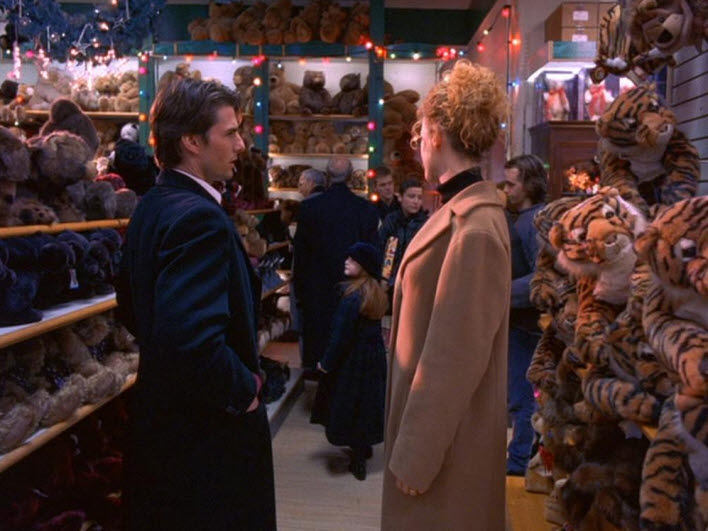
When it looks like Alice had her own sexual adventure in a subconscious way during the previous night, we naturally come to question Dr. Harford’s supposedly solid viewpoint. As a matter of fact, his dramatic nocturnal drama is so full of coincidences and accidental opportunities that it often feels like driven by some dream logic, and this dreamy aspect is further accentuated by the frequent placing of colorful Christmas season lightings on the screen.
I guess we are not supposed to expect any kind of realism from the beginning because the movie is based on Arthur Schnitzler’s 1926 novella “Traumnovelle”, whose title means “Dream Novel” in German. Besides, Kubrick chose to shot most of his film in England as he did in “The Shining” (1980) and “Full Metal Jacket” (1987), and New York City in the film surely looks artificial at times even though Kubrick and his crew members including cinematographer Larry Smith try their best to recreate those NYC streets on the screen.
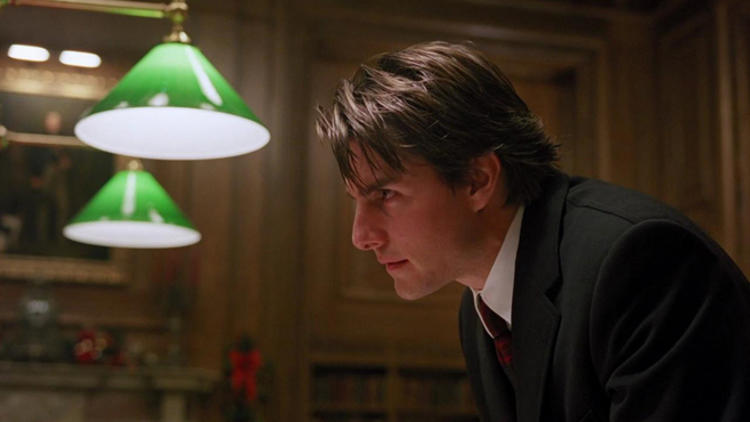
Because Kubrick happened to pass away shortly before submitting his final cut to the Warner Brothers Company, we are not entirely sure about whether what we have now was exactly what Kubrick really intended, but the movie still distinguishes itself enough while often showing his distinctive touches. As usual, every shot in the film is carefully and precisely composed for his overall artistic vision, and it also shows some wry sense of black humor – especially as Dr. Harford is seduced in one way or another along the story.
Tom Cruise, who had to spend more than one year in England along with Nicole Kidman for the shooting of the film, is rather flat in his neutral performance, but he is effective as a plain canvass for several other main cast members, and the movie has lots of naughty fun with how his usual confident screen persona is shaken or threatened here and there. While Kidman is particularly terrific during her several big scenes with Cruise, a number of other notable performers including Sydney Pollack, Todd Field, Marie Richardson, Rade Šerbedžija, Vinessa Shaw, and Alan Cumming also have each own fun around Cruise, and Pollack ably exudes his character’s avuncular insidiousness during a certain key scene with Cruise around the end of the film.
In conclusion, “Eyes Wide Shut” is one or two steps from the greatness of Kubrick’s best works such as “2001: A Space Odyssey” (1968), but it is still quite a fascinating psychological drama about seduction and transgression. It is not wholly without flaws, and the ending feels rather contrived in my humble opinion, but now I am musing a bit more on the last line of the film. Well, who could have guessed that would be the very last word of Kubrick’s long and illustrious filmmaking career?


 Seongyong's Private Place