
Paul Thomas Anderson’s “Magnolia” still knocks me down although it has been almost 25 years since it came out in 1999. Masterfully and electrifyingly juggling many different narratives unfolded in the San Fernando Valley, California during one particularly eventful day, this ambitious cinematic symphony boldly attempts to give us a vivid and palpable human tapestry of misery, resentment, compassion, and forgiveness, and this will overpower you and then touch you a lot for many good reasons. To be frank with you, it is often amazing to see how everything in this epic piece of work mostly remains under full control even when the movie seems to be pushing itself too far with all those broad dramatic strokes – and how it somehow pulls off a truly elevating moment of catharsis and consolation for everyone in the story in the end.
Like many other similar films ranging from Robert Altman’s “Short Cuts” (1993) to Paul Haggis’ “Crash” (2004), the movie focuses on a number of various characters who happen to be in a complex web of connection and relationship of which only we and the movie are fully aware. As each of their stories interconnects or resonates in one way or another, we naturally come to muse more on coincidence and inevitability in our life, and the movie even presents several odd cases of coincidence at the very beginning. In case of a very bizarre incident somehow between suicide and manslaughter, we are initially amused by how everything came to click together precisely in this horrific but absurd tragicomedy, but then, as observing its devastating aftermath, we cannot help but wonder: Is this just a mere coincidence or actually a macabre joke of fate?
The central story element holding every main character in the story is a fictional popular TV quiz show, and the first act of the film details their respective connections with that TV quiz show. We meet the longtime host of the TV quiz show, and then we come to gather how things have been messy in both of his professional and private life. We meet a dying man who is the producer of the TV quiz show, and then we get to know how two family members of his have been tormented in each own way. We meet a smart little kid who has been the rising star of the TV quiz show, and then we observe the bitter parallels between this deeply unhappy boy and one pathetic loser who was once not so different from him many years ago. In addition, we also meet a good-hearted but lonely police officer who has been longing for love and connection for some time, and then we watch him tentatively approaching to a very troubled young woman after their accidental encounter.

As the movie briskly shuffles among its numerous main characters, we come to notice how miserable many of them are as desperately struggling with each own guilt or torment. For instance, after learning that he has only a few months to live due to his terminal illness, Jimmy Gator (Philip Baker Hall), the aging host of the TV quiz show, attempts to have any kind of reconciliation with his estranged daughter, but Claudia (Melora Walters), who is incidentally the aforementioned troubled young woman, is still angry and resentful due to his sexual abuse in the past. His unexpected visit only comes to make her quite furious and hysterical, while his wife Rose (Melinda Dillan) wonders more about what really happened between them.
In case of Earl Partridge (Jason Robards), another guilt-ridden dying figure involved with the TV quiz show, time is virtually running out for him second by second as he is on his deathbed. While his wife Linda (Julianne Moore) is coping with her growing guilt about neglecting her older husband for years, Earl really wants to see his only son he abandoned a long time ago, and his caring nurse Phil (Philip Seymour Hoffman) is quite willing to help as much as he can. However, locating and then contacting with Earl’s son turns out to be rather difficult, even though he has been pretty well-known in the area under his changed name.
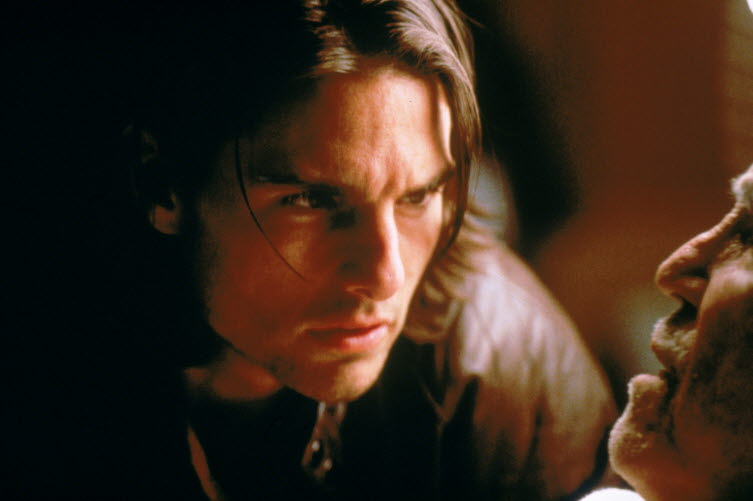
Right from his very first scene, Earl’s son, Frank T.J. Mackey (Tom Cruise), shows us what an ironic case study he is. As a sleazy but charismatic motivation speaker who “educates” his male clients on how to “seduce and conquer” women, he proudly embodies every toxic male influence from his father even though he still hates his father, and we are simultaneously fascinated and repelled by every misogynistic aspect of his, which incidentally feels all the more glaring at present thanks to the #MeToo era. After all, we all have seen many cases of how the abused become abusers later as starting another cycle of abuse, haven’t we?
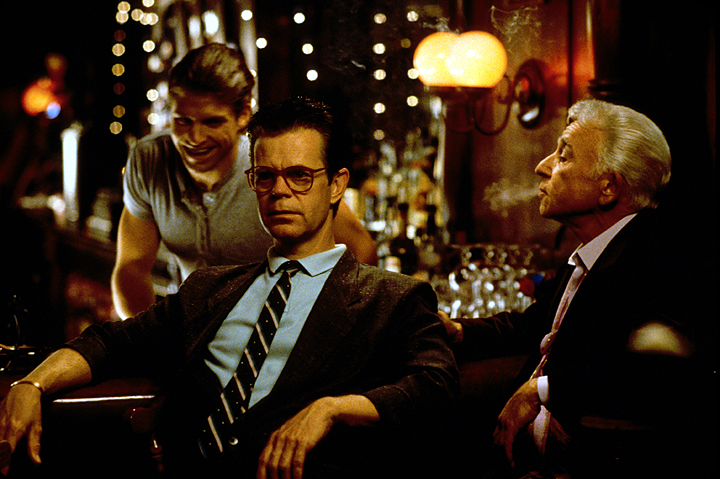
For that kid star of the TV quiz show, Stanley Spector (Jeremy Blackman), parental abuse is a serious present matter to him right now. Constantly pushed by not only his greedy father but also several others around him, he is expected to give a right answer everytime at the TV quiz show, but he is now more tired and confused than ever as feeling more misery and loneliness than before. Stanley’s situation comes to function as a sort of mirror image to Donnie Smith (William H. Macy), who still clings onto his glory days at the TV quiz show in the past although that does not mean anything at all now. Donnie has a painfully sad scene when he clumsily confesses his longtime crush on the bartender of his frequent bar, and that is followed by the recurring quote of the movie: “We might be through with the past, but the past ain’t through with us.”
How the movie gradually builds up the level of emotional intensity around these and other main characters during the middle of the story is utterly spellbinding. While the fluidly dynamic camera work by cinematographer Robert Elswit immerses us more into the ongoing individual dramas of the main characters, the efficient editing by Dylan Tichenor never gets us lost despite its busy shuffling of characters, and the movie eventually culminates to the powerful dramatic point where many of its main characters go through each own excruciating emotional meltdown.
Not long after that point, the movie throws a relatively subdued sequence where its main characters sing Aimee Mann’s “Wise Up” one by one. This initially looks like an overkill, but it is another sublime moment showing how Anderson skillfully conducts every main character of his story under his confident artistic control, and we come to feel for them more than before.
Furthermore, a diverse array of performers in the film effectively gel together as Anderson’s dependable orchestra members. While Tom Cruise, who was deservedly Oscar-nominated for his fearless performance here in this film, is surely the most prominent cast member in the bunch, he is also smoothly mixed into the ensemble, and so are other notable cast members including Julianne Moore, Philip Seymour Hoffman, William H. Macy, Philip Baker Hall, and John C. Reilly, whose cop character, along with Hoffman’s nurse character, slowly emerges as the voice of kindness and compassion along the story.

In case of that famous climactic moment which I will not discuss here in details, it feels so unexpected that you may find it quite jarring compared to what has been realistically built up to that point. Nevertheless, I think this moment works as an apt resolution after the overwhelmingly aching presentation of human pain and guilt during more than 2 hours. After all, every part of the story desperately and harrowingly cries for any kind of absolution or closure, and such an unbelievably biblical happening like that is probably the only possible way to ventilate and resolve everything in the story, just like that odd ending of Anderson’s subsequent film “There Will Be Blood” (2007) seems to be the only logical narrative exit for its relentless story and lead character.
It is really astonishing that “Magnolia” was only Anderson’s third feature film after “Hard Eight” (1996) and “Boogie Nights” (1997). With these two previous films, Anderson quickly established himself as a new exciting talent to watch, and then, as we all know, he has risen much further as becoming one of the most interesting filmmakers of our time after “Magnolia”, which is still one of his best works to date. He was only 29 at that time, but the movie is not only quite youthful and energetic in style but also remarkably matured and insightful in substance, and you may come to have more understanding and compassion on others around you after watching it.
By the way, “Magnolia” is one of a few precious movies which really sensitized me in many aspects. Like “Short Cuts” or “Crash”, the movie really made me feel something strong, and I am still grateful to it for providing a valuable emotional breakthrough for me in not only assessing movies but also empathizing with other people around me. Yes, as a guy who has a mild case of autism spectrum, I am not usually that good at interacting with people, but I learned a bit about people via “Magnolia”, and the compassionate message behind its story and characters reminds me that I still has to learn more.


 Seongyong's Private Place