
Netflix documentary film “Sky Ladder: The Art of Cai Guo-Qiang” will engage and then amaze you even if you are not that familiar with the artistic career of renowned Chinese artist Cai Guo-Qiang (Full disclosure: Neither am I). Here is an exceptional artist who has steadily explored his own areas of artistry for many years, and you will be impressed a lot by not only his palpable artistic spirit but also his gentle humanity.
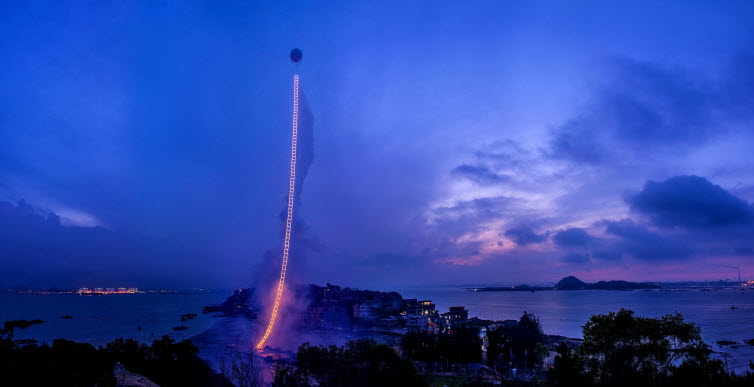
The title of the documentary comes from Cai Guo-Giang’s old passion project which had somehow been aborted more than once for more than 30 years. After his first attempt was unfortunately aborted in 1984, Cai made several subsequent attempts during next 30 years, but all of these attempts of his were failed due to one unexpected reason after another. Nevertheless, he does not give up at all, and the early part of the documentary shows him eagerly preparing for his latest attempt in his hometown step by step.
Besides its artistic significance, trying his passion project, which will incidentally present a huge ladder of fireworks in the sky, in his hometown means a lot to Cai. After all, he was influenced a lot by his artist father who often put art and sophistication above anything else, and that is why the Cultural Revolution in China during the 1960-70s was so painful to young Cai, though now he wryly tells his daughter about a darkly humorous personal episode involved with those hostile Red Guards.

When he grew older in the 1980s and searched for his own artistic style and personality outside his father’s artistic influence, Cai happened to be in the right time for that. Once China opened itself to the outside world after the end of the Cultural Revolution, many young Chinese people like Cai were quite willing to embrace new things, and he soon came upon unexpected artistic potentials in firework. At first, he simply utilized firework for the extra touches for his early drawings, but then he went deeper into its undiscovered artistic potentials, and that soon became the major source of his artistic inspiration.
Eventually, Cai and his wife went to Japan because he needed more artistic freedom, and then they moved to US, where he quickly drew lots of attention in public for his striking artistic style and sensibility. Besides a number of stellar works of installation art which look still quite impressive, he deftly used fireworks for more artistic expressions to be added to his art exhibitions, and those fireworks soon became his own trademark to be known in public.
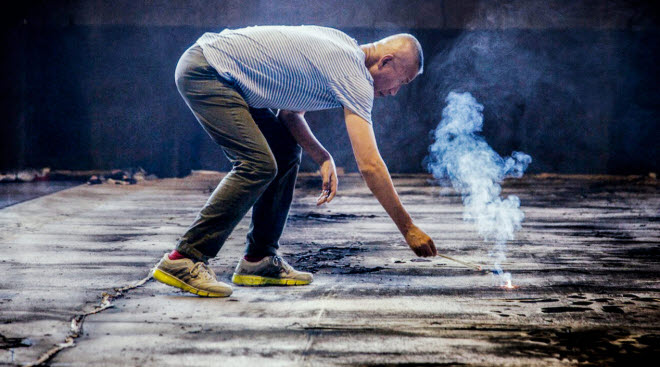
And we get to know a bit about how Cai and those people working with him carefully prepare for his firework shows. Yes, they surely care a lot about the various types of fireworks to be used for the shows, but they also pay considerable attention to how the components of his firework shows are arranged in terms of space and time. This is actually possible thanks to a tiny remote electronic detonator which can be attached to each firecracker, and you will be surprised by how exact and precise this detonator can be.
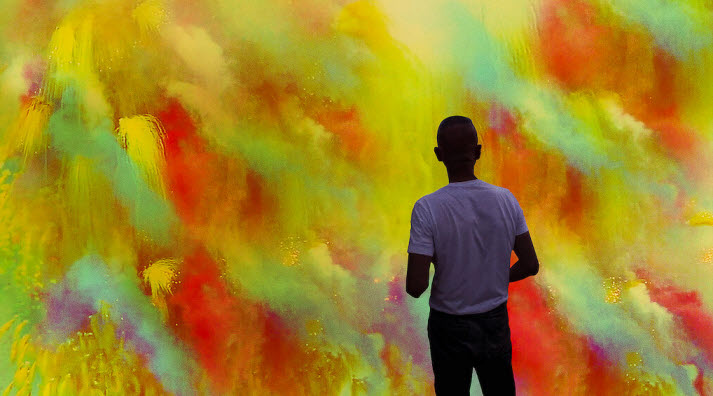
Via this and other useful technical tools, Cai and his team usually get things under his total artistic control, and the results are often amazing to say the least. At one point, the documentary simply observes the process of his latest firework performance step by step, but you will instantly admire how all those colors and smokes from numerous firecrackers serve Cai’s ambitious artistic vision.
When he was asked to participate in the preparation for the opening ceremony for the 2008 Summer Olympics in Beijing, China, Cai was willing to throw himself into more challenges, though he was also well aware of the undeniable political aspects of his participation. He just did his best at that time, and he is proud of the final result, but we cannot help but help sense his deep reservation while watching him visiting the Tiananmen Square at one point. He may can accept some compromise for working for his home country, but he later became quite disillusioned when he ended up virtually suppressing himself in his next subject with the Chinese government in 2014. As a big-time artist, he knows too well that he always has to balance himself between idealism and pragmatism, but this turned out to be too much for him – even when he was consoled a bit by a certain famous Chinese filmmaker who happened to work with him again after their fruitful collaboration in the 2008 Summer Olympics in Beijing.
Anyway, this professional frustration made Cai more drawn to maintaining his artistic root and integrity, and he also came to pay more attention to accomplishing his passion project. We see him collaborating a lot with a bunch of local people in his hometown, and he is certainly very excited right before the eventual showtime, which will incidentally be watched by not only many local people but also his 100-year-old grandmother.
On the whole, “Sky Ladder: The Art of Cai Guo-Qiang” is an engaging documentary, and director Kevin Macdonald, who has been known for several acclaimed documentaries including “Touching the Void” (2003), and his crew members including cinematographers Robert Yeoman and Florian Zinke did a solid job of presenting Cai’s life and career with enough care and respect. In short, this is one of more entertaining Netflix documentaries during last several years, and you may find yourself becoming more interested in its main subject after watching it.


 Seongyong's Private Place