

South Korean independent film “Dream Palace” is about one ordinary woman’s increasingly grim and stressful situation which is frighteningly realistic at times. As having been quite frustrated with the deeply flawed system and society, she willingly chooses to make some compromise for living a bit easily, but, unfortunately, her understandable choices lead to lots of troubles for not only herself but also several others around her.
The early part of the film gradually lets us know its heroine’s current circumstance. A few years ago, Hye-jeong (Kim Sun-young) lost her husband due to some big accident at a big factory where he worked, and she and a group of surviving family members of the other victims of that accident protested against the owner of that factory, but they have been only ignored and cornered a lot while still not knowing what really happened at that time. In the end, Hye-jeong decided to settle with the company, and she recently moved into a newly built apartment thanks to the settlement fee.
However, her apartment turns out to be quite problematic behind its supposedly cozy appearance. Right from her first day, Hye-jeong discovers that her apartment has a serious plumbing problem, so she demands the necessary repair for that, but nobody is particularly interested in helping her. While an employee of the company which built her apartment building simply tells her that she will have to wait until the company sells all the remaining apartments, her new neighbors are more concerned about maintaining the current value of their apartment buildings by any means necessary, and that makes Hye-jeong all the more frustrated than before.
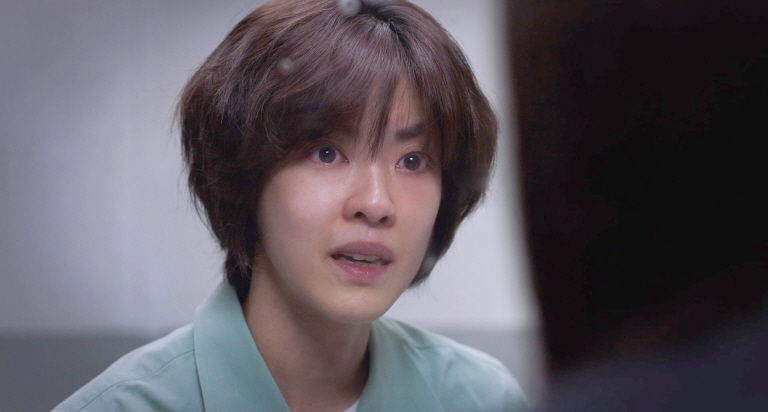
At first, it looks like there is a way to solve her problem. All Hye-jeong will have to do is advertising her apartment town more for luring potential buyers to fill the empty spots in the apartment town, and that company employee even promises to her that she will get some incentive if she succeeds in that task. As a matter of fact, she even recommends her apartment town to her friend Soo-in (Lee Yoon-ji) later, who also lost her husband due to that accident and, after going through another hard time due to one little incident, eventually decided to give up and then accept the settlement just like Hye-jeong.
And she keeps looking away from those people with whom she once fought against her husband’s company, which still does not do anything at all as before. At one point, the leader of the group approaches to Hye-jeong for some desperate request, but Hye-jeong flatly refuses as remembering how much she was isolated and desperate before accepting the settlement in the end. She probably should not have accepted the settlement from the beginning, but, as she bitterly points out, nobody was willing to support or help her just because it seemed that her husband was mainly responsible for that accident at that time.
Not so surprisingly, things get worse and worse for Hye-jeong along the story. While she subsequently receives more anger and resentment from her former colleagues, she also finds herself becoming the main target of her new neighbors’ ire and spite just because of her seemingly harmless advertising activity. When the value of their apartments is seriously threatened, they decide to become more active than before, and Hye-jeong becomes all the more unwelcomed by them than before.
Meanwhile, Hye-jeong’s very stressful situation also affects her relationship with her adolescent son Tae-hoon (Choi Min-young). While initially not having much problem with his mother’s decisions, Tae-hoon becomes more and more conflicted as watching the following consequences of his mother’s actions, and that makes him a lot more estranged from his mother.

We mostly observe Hye-jeong’s ongoing plight from the distance because she virtually asked for it from the start, but we also become more emotionally involved in the consequences of her actions because we understand why she made such questionable compromises. All she wants is having a normal life again, and that seemed to come easily once she bent herself a little, but, to her despair and exasperation, the price for that turns out to be much bigger than she expected at first.
During its inevitable last act, the screenplay by director/writer Ka Sung-moon corners its heroine a bit too hard in my trivial opinion, but Kim Sun-young’s harrowing lead performance continues to hold our attention as before. You may not like Hye-jeong that much for numerous reasons, but Kim’s nuanced acting presents her character as a complex human figure to observe and understand, and we are relieved a bit when the movie eventually allows some relief to her character around the end of the story. As the two substantial supporting characters around Kim, Lee Yoon-ji and Choi Min-young are well cast in their respective roles, and Lee is particularly devastating during one particularly intense conversation scene between her and Kim.
In conclusion, “Dream Palace” is another troubling South Korean drama film powerfully and painfully illuminating the problematic aspects of the South Korean society. It is surely tough to watch to say the least, but it is worthwhile to watch thanks to its solid direction and good performance, and you will come to reflect more on its main social issues once the movie is over.


 Seongyong's Private Place
I newly watched it. Maybe Netflix’s version has been edited somehow, so that the storyline appears not so understandable. Your article helps me seeing through many things. Thanks for the writing.
The protagonist lacks some basic risk management abilities, in my view. When a 2% incentive was offered for selling, she recklessly printed altered posters with her phone number. At that time, I was thinking if she had a well-thought plot to punish the estate developer. But it turns out she merely sold one to a close friend. Consequently, Dream Palace Ltd. managed to initiate the 30% discount clearance using her name for the tenant group to attack. If she had the intelligence to sell one apartment to a stranger, why didn’t she sell her own to get rid of the water problem?
Another puzzle is who damaged her vehicle. I suspect her son but the motive would be strange. What do you think?
SC: 1) I guess she cannot sell the apartment due to that very water problem.
2) I think the suspect is some other supporting character in the film, but I am not so sure.