

What are they doing? After watching the interactions between two characters for a while, you will be bound to have that question at the certain point in “Certified Copy”. While being deceptively simple, the movie shows us the ambiguous but curious dynamic between two strangers(or were they?), whose inscrutable sides are intriguing enough to lead us to some thoughts on the reality shown on the screen.
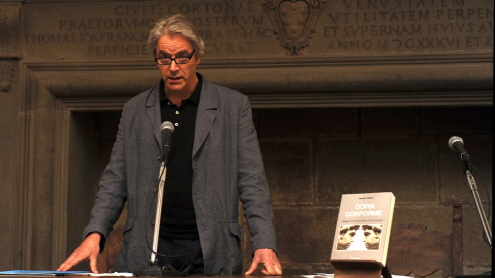
At first, it can be accepted that they are strangers to each other. A British art historian James Miller(William Shimell) is visiting Italy for promoting his latest book “Certified Copy”, which delves into the matter of the original and copies. In the opening scene, he talks about his book and the motive behind it to the audiences including a French woman(Juliette Binoche), who comes to the lecture later than him. While her son gives little annoyance to her, she talks something to Miller’s Italian translator in his ear, gives him a note, and leaves the place.
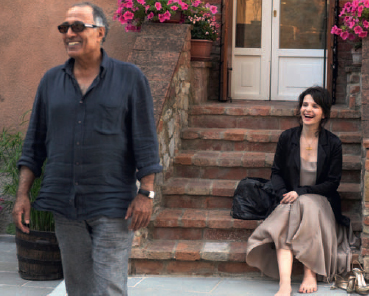
Later, Miller visits the antique shop run by that unnamed woman(according to IMDB, her name is Elle but her name is never mentioned in the film). After having some conversation with her, he accepts her offer, and they spend the afternoon together. They go to a nearby town by her car. They visit the museum in that town. They drop by some cafe. They walk around the town. They continue to talk and discuss about his book and its theme. And the relationship between them seems to be transformed into more intimate than we thought at first.
The turning point of this subtle process comes around during the cafe scene. While Miller gets out of the cafe for answering his cell phone, she is approached by the cafe owner, a middle-aged lady, who assumes she and Miller are a wife and a husband. She does not correct the misunderstanding while complaining about her husband’s indifference to the cafe owner. She tells Miller about this amusing misunderstanding when he comes back. After leaving the cafe, she behaves as if he were her husband. He goes along with that. As the time goes by, they begin to resemble a married couple.
While observing their role-playing, we begin to ask ourselves: were they a couple from the beginning? I do not think so due to several reasons shown during the first half of the film. But, even if we settle on that matter, we still cannot be entirely sure about what they feel or think throughout the movie. Their role-playing can be more or less than the flirtation to both of them, but there is always something enigmatic about their interactions, and the film does not have any explanation for that.

Both Juliette Binoche(she won Best Actress award at Cannes Film Festival for this movie in last year) and William Shimell, are engaging enough to hold our attention while never giving us any clues that might ruin the tantalizingly elusive side of their relationship. Binoche shows her versatility in going through several different, contradicting modes without awkwardness. Shimell, who has no previous acting experience before this movie, ably supports her with his calm performance. Their nuanced performances always show one thing while suggesting the other things, even when their situation goes a little more melodramatic when they talk about the problems in their, uh, past.
The movie sometimes feels a little bit heavy-handed whenever emphasizing its theme through the characters, but the director Abbas Kiarostami’s effortless approach compensates for its weakness. Through careful long takes and close-ups, he subtly increases our intimacy to his characters. Even we are wondering about who they really are, we are still close to them none the less.
Some of Kiarostami’s notable works were introduced to South Korea around the time I got interested in movies. One interesting thing about “Through the Olive Trees”(1994) is that, as a movie about making movie, it is fictionally framed into his another movie “And Life Goes On,..”(1992), which is fictionally connected to his another work “Where is My Friend’s Home?”(1987). While they can be appreciated individually, they also make the interesting picture of the reality and the fiction as the copy of the former.
 That aspect is extended to the difference between original and copy questioned in “Certified Copy”. In the middle of the movie, the characters see the painting in the museum which turned out to be not the original but has been valued as its copy. That ignites another discussion between them: can copy be as good as original? Miller thinks so; he argues that with Leonardo DaVinci’s “Mona Lisa” as the example. In his view, “Mona Lisa” is basically the copy of some woman that existed in the past, but people value it anyway. And, in biological view, that woman was the complex copy of human genomic materials mixed with some variations. If so, can it be said that there is no original in the world, after all? And are we watching the copies of one relationship in this movie?
It throws these questions and others to us without providing answers for them, while confounding us with the amorphous relationship that can be interpreted in more than one way. With its vagueness, “Certified Copy” could have been a distant intellectual exercise, but it is a fascinating movie with good performances and subtle direction to draw our interest to its enigma and thoughts surrounding it. I am still not so sure about who they are, but this is a well-made copy that made me very curious about what I saw on the screen.


 Seongyong's Private Place
Kia has been a favorit but this film has either been evading me or vice versa. I read only your first three paras and that decides I have to see it. So more later.
SC: I hope to watch his other works beside the ones I mentioned, BTW.
Have you seen Shirin? Unusual, since the camera is only scanning the audience. I was fascinated in an Asian sense.
SC: I have heard about the movie. It sounds like a challenging experience.
Spell binding more than challenging. The camera intrudes into the private emotions of a gallery of beautiful women in a darkened chamber as they respond to a heart rending Persian romantic classic. We participate in the stage drama itself through the resonance of the voices. It is said that it is the voice which has the power to penetrate deepest into the heart or soul.
I have never forgotten this film with it’s sublime psycho-sexuality
SC: Thanks for its description. I’m more interested.