
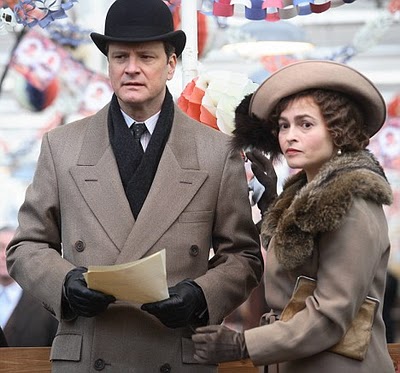
While watching movies, I sometimes come across the strong emphatic moments because I understand well how the characters feel in their situations. One of recent examples was from “The Hurt Locker”. Although its hero was someone quite different from me, when I saw him at a loss in the market scene near the end, I immediately understood his trouble for I knew how it had been difficult for me in similar situations.
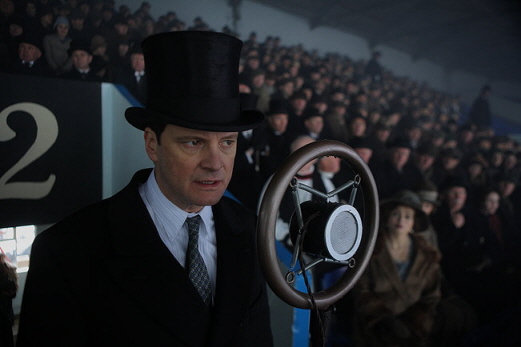
“The King’s Speech” starts with such a scene like that. It is 1925, and The Prince Albert(Colin Firth), the Duke of York and the second son of King George V, is about to give the closing speech for the British Empire Exhibition at Wembley Stadium. His father and his older brother have already made their first public speech for radio broadcast, and now it is his turn. Everything is ready for him, but there is a big problem. In addition to being very nervous, he struggles with stammer right from the beginning of his speech, and he has to endure painful shame while trying to hide it in front of people. While watching this scene, I reflected on how disastrous my presentations had been due to my nervousness and stutters in front of others at my department. Some even said they were something they would not forget.
 He and his wife Elizabeth(Helena Bonham Carter) try to find a way to cure his problem. They tried several treatments, but there is no visible success, so The Prince chooses not to meet another doctor anymore. However, as a wife who sincerely cares about her husband’s problem and pains resulted from that, Elizabeth goes to some unorthodox speech therapist on one foggy day of London in 1934.
His name is Lionel Logue(Geoffrey Rush), an Australian actor whose second job almost becomes his main job(But he still tries to get the part in the audition for a Shakespeare play). From the first time he meets Elizabeth, and then the Prince, Logue insists on his own conditions and rules. The therapy sessions have to be held in his workplace only with him and the Prince. Also, as a therapist and a client, they have to talk with each other in a casual way. Even when Logue learns that “Mrs. Johnson” is not an ordinary housewife, he does not change his position, so he becomes only common man who can call the Duke of York “Bertie”, a nickname exclusively used by his royal family.

It looked unconventional at that time, but Logue’s method is pretty much conventional to us in the 21th century. While externally helping his client in several physical ways for vocalization enhancement through a funny montage sequence, Logue also internally approaches to the Prince’s problem. As he admits, he is not a doctor with the degree, let alone the certification, but he is a well-experienced professional. He knows the importance of the mutual trust without formality between him and the Prince, and he tries to talk like a friend to the Prince. The Prince is hesitant about this at first, but, with Logue’s stimulation, he begins to talk about his inner bruises he has to cover as the King’s son, and they get close to each other.
The movie basically tells a familiar tale about the friendship, the love, and the personal triumph from overcoming obstacle, all mixed dramatically in the historical context. Although being dutiful as the members of the royal family, Prince Albert and his wife have little interest in being public figures, but the roles far more burdensome than they have ever imagined come to them. After his father’s death, his older brother Edward becomes the new king, King Edward VIII, but he is too irresponsible as the King of Britain while the crisis is coming to Europe and Britain. Furthermore, he wants to marry that infamous Mrs. Simpson, an American divorcee whom he is not allowed to marry according to the constitutional law.
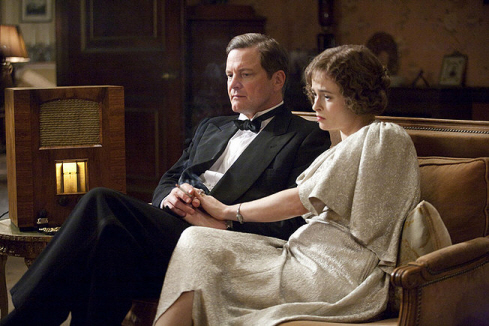
Fortunately for Britain, he eventually decides to abdicate the crown to marry her, and now that heavy duty(and heavy crown as well) is handed to Prince Albert. As King George VI, he soon has to face the national crisis as the symbol of the British Empire. He knows he must do his duty in spite of his agony and reluctance, and the support from his wife and Logue is more valuable than before.
David Seidler’s clever screenplay presents the characters as ordinary people whom we can easily identify with. The relationships between them are depicted warmly while being handled with intelligence and wits, and Seidler effectively overlaps their intimate drama with historical incidents that place them in the crucial part of the 20th Century history. The film also amusingly points out the change modern technology brought to its society at that time. As King George V grudgingly tells to his son, thanks to modern technology, their family becomes “the lowest beasts of the creatures” who has to do more than posing as the royal family – now they have to be the performers to ingratiate themselves with their people. The trend has never been changed, and, while watching young Elizabeth II, George VI’s daughter, in the movie, I recall how she reluctantly had to perform a certain act as her people demand later, as shown in Stephen Frears’ “The Queen”(2006).
As widely known, Seidler actually conceived the idea for this movie in more than 30 years ago. But the Queen mother asked him not to write about her husband in her lifetime, so he gave it up for a while. But, after all, it turned out to be the reversal of fortune. After her death, his story met right people to make this movie, and, in the end, he got an Oscar in last month.
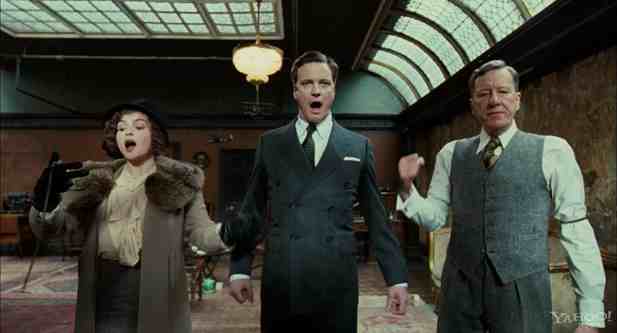
Three main actors grace the movie with their wonderful performances, and they do deserve Oscar nominations they respectively receive. Colin Firth’s career has been relatively quiet after TV series “Pride and Prejudice” in spite of constant appearances in the films, but he has been diligently ascending with good performances, including a restrained but deeply sorrowful Oscar-nominated performance in “A Single Man”(2009). Like Helen Mirren in “The Queen”, he gets the role perfectly made for him in this movie, and he won an Oscar for one of the exceptional performances in 2010. In one scene, when his character realizes the relationship with his loving daughters is not the same as before due to his changed status, Firth subtly conveys his little sadness to us.
Considering the theatrical bravado of his character, Geoffrey Rush is an ideal choice for playing His majesty’s therapist(No wonder they broke some rules for sending him the script). His witty performance is heartfelt as the half of the special friendship in the story, and the dynamic between him and Firth on the screen is always captivating – whether it is the conversation between them or the climax sequence where they have to go through the crucial moment together. Quite unlike mean Red Queen we saw earlier in “Alice in Wonderland”, Helena Bonham Carter comes to us as a gentle, no-nonsense Queen with her warm performance. In the opening scene, you instantly know from her face that she is deeply saddened by her husband’s humiliation, although she does not say anything. There are also many notable actors in supporting roles, including Michael Gambon and Claire Bloom as King George V and his wife, Guy Pierce as selfish King Edward VIII, Timothy Spall as Winston Churchill, and Jennifer Ehle, who co-played with Firth in TV series “Pride and Prejudice”, as Logue’s wife.
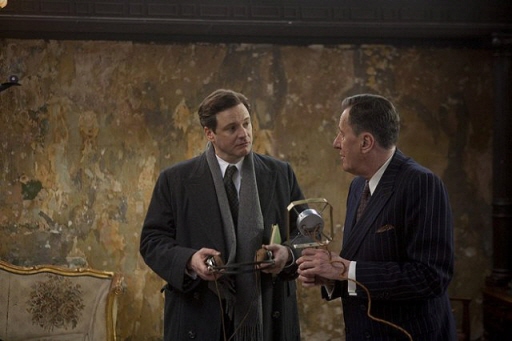
The story was probably quite familiar to the director Tom Hooper, whose first theatrical movie, “The Damned United”(2009), was also about a rocky friendship between two characters based on real-life figures. Although “The King’s Speech” is his second theatrical movie, Hooper is an experienced director who has worked in TV dramas, and he focuses on the story and the characters with several notable technical choices. Using wider than normal lens, he accentuates the constricted emotional state of his hero as well as the narrow, vertical, and overwhelming feelings generated from the sets. The film is a British period drama, but, it is the 1930s after the depression, so the sets and the costumes, while faithful to the period, are relatively economic and plain compared to other period dramas.
Despite its small scale, “The King’s Speech” is a moving drama with lots of dramatic power. Its climax mostly depends on two characters and a microphone in a small place, but the film marvelously creates the powerful moment when a small personal triumph is amplified into a public one all over the world. The movie is good enough to capture Academy voters’ hearts, and, as a result, it won four Oscars including Best Picture. We will still talk about the greatness of “The Social Network” years later, but I am sure that “The King’s Speech” will also still remain as a likable movie to the next generation.


 Seongyong's Private Place
Nice movie, nice review. Who doesn’t love stories about kings and queens and the British monarchy seems to be growing into a genre! The movie was made with delicacy and characteristically British understatement and was very enjoyable.
SC: The British monarchy has always been interesting material for good movies, and it will be.
I always wonder if the scene with the king’s speech would have been more powerful if no music had been playing underneath it , especially when it gets louder and threatens to overwhelm the speech itself (though the 2nd movement of Beethoven’s 7th was a good choice, if one were to have music in this scene).
I also was bothered by the scene in Westminster Abbey where Firth’s character reveals what he has found out about Rush’s character. Though both actors handle that scene well, as a plot point it seems thrown in.
Otherwise, a fine film with some really great acting in it.
SC: But the music is necessary for a conductor and a performer, isn’t it?