
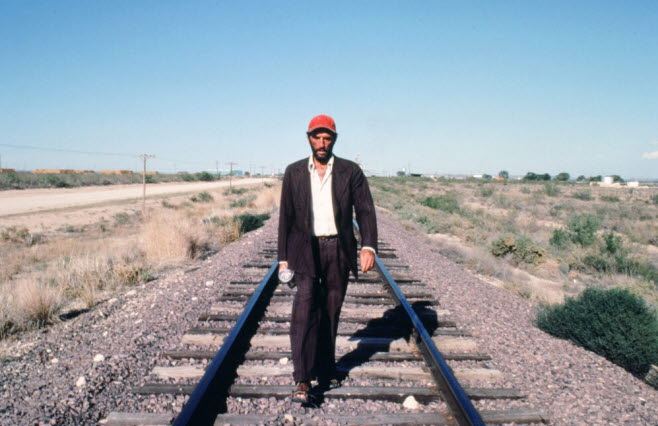
Wim Wenders’ 1984 film “Paris, Texas”, which was shown along with his several other works at selected South Korean theaters during last two weeks, initially drew my attention with all those haunting shots distinctively American in my humble opinion. We often see cars, roads, and motels in the wide landscape shots throughout the film, and these elements come to accentuate its plain solitary hero’s personal journey along the story as we come to care more about him.
Harry Dean Stanton, who was one of most dependable American character actors before passing away in 2017, plays the hero of the story, and the early part of the film gradually establishes this rather taciturn character. His name is Travis Henderson, and the calm opening scene of the movie shows him aimlessly wandering in the middle of some remote desert area of Texas before eventually arriving and then collapsing at some shabby convenient store.
Fortunately, Travis happens to have a calling card from his brother Walt (Dean Stockwell), who immediately comes from California right after getting the call from a doctor who examined Travis. However, Travis remains quite unresponsive even when he meets his brother, who understandably becomes frustrated but still tries to help Travis as much as possible.
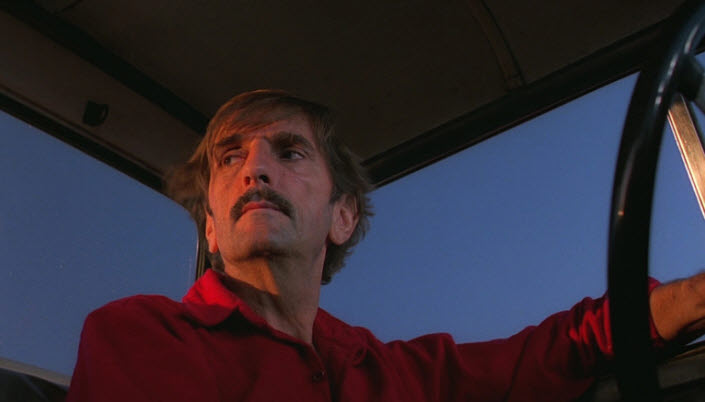
As time goes by, Travis becomes a bit more responsive, and we get to know a bit more about what happened to him around four years ago. He was married, and he and his wife Jane (Nastassja Kinski) had a son between them, but she left him under a rather unspecified circumstance. As a result, he became quite remorseful as wandering here and there for simply looking for her during last four years, and his young son Hunter (Hunter Carson) grew up under Walt and his French wife Anne (Aurore Clément) in the meantime.
Just because Travis does not feel so right about getting on an airplane, he and Walt end up going together to Walt’s home in California by a car (I wonder whether this inspired the story setting of Barry Levinson’s Oscar-winning film “Rain Man” (1988), by the way). As Walt or Travis drives the car, Wenders’ frequent cinematographer Robby Müller gives us a series of lovely landscape shots to admire, and we become all the more immersed in the slow but steady mood of the film.
When Travis eventually arrives at Walt’s house along with Walt, the mood is certainly awkward between Travis and Hunter, who has regarded Walt and Anne as his parents and does not remember that much about his early years with Travis and Jane. Nevertheless, it does not take much time for Hunter to befriend Travis, and this helps Travis come out of his shell a bit more than before.
While there naturally comes a little conflict as Anne and Walt becomes concerned about how to handle the complicated situation among them, Travis, and Hutner, but the screenplay by Sam Shepard and L.M. Kit Carton thankfully does not resort to contrived melodrama. When Anne eventually makes a certain choice at one point later in the film, that may look a bit selfish, but we also sense that she does that because she sincerely wants to help Travis to some degree.
I will not go into detail on what follows next, except telling you that there comes another journey for Travis and he comes to open himself much more than before. While the story reaches to a poignant emotional climax as Travis finally arrives at the end of his journey, what happens to Travis before that point is also important in terms of story and character development, and we come to have more empathy toward him when the movie is over.
Stanton’s humble but unforgettable low-key performance steadily anchors the film from the beginning to the end. Even when his character does not seem to signify much on the surface, Stanton subtly conveys to us the immense sadness behind his phlegmatically weary appearance, and he is absolutely terrific when his character gradually lets out his feelings and thoughts during that climactic moment. Although he simply talks and talks without raising his voice at all, the sense of guilt and regret becomes more palpable to us, and we are all the more touched by that.
Around Stanton, several main cast members in the movie hold each own place well. Dean Stockwell, who was almost retired at that time, brings some human warmth to the story along with Aurore Clément, and he subsequently became more active in addition to being Oscar-nominated for his funny supporting turn in Jonathan Demme’s “Married to the Mob” (1988). While Hunter Carson, who is the incidentally Carson’s son, is solid in his unadorned natural acting, Nastassja Kinski, who is virtually the Colonel Kurtz of the story, brings enough presence and sensitivity to her supporting role, and her expressive face is one of the crucial elements in that climactic moment.
On the whole, “Paris, Texas”, whose title comes from a real Texan city with which its hero has some personal connections, is one of the best films from Wenders. After I encountered it for the first time around 2005, I did not watch it again for more than 20 years, but I soon got engaged during the first 30 minutes, and its many timeless moments awaken my remaining old memories of the movie. That is what a great movie can do, isn’t it?



 Seongyong's Private Place