
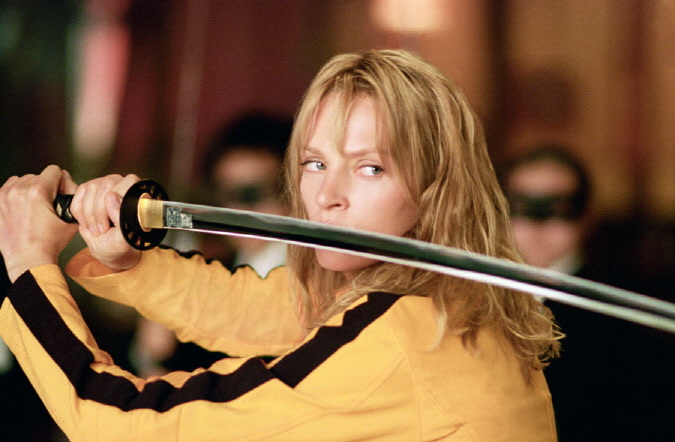
Quentin Tarantino’s “Kill Bill: The Whole Bloody Affair” gives us the complete version of what he envisioned from the very beginning. While both “Kill Bill: Volume 1” (2003) and “Kill Bill: Volume 2” (2004) are quite fun to watch individually, they are seamlessly connected and then resonate together here in this version as he wanted, and it shows us more of how fun and ambitious this magnum opus of Tarantino really is.
The story is more or less than a simple and superficial clothesline for a series of sequences just like many of Tarantino’s works such as “Inglourious Basterds” (2009). The heroine of the film, “the Bride” (Uma Thurman), was a former member of some infamous assassination squad, but, for a personal reason to be revealed later in the story, she subsequently decided to have a simple normal life as marrying some plain dude in El Paso, Texas. However, her boss/lover, who is incidentally named Bill (David Carradine), does not approve of that, and he and several other assassins brutally shoot not only the Bride but also several other innocent people who unfortunately happens to be on the spot.
Fortunately, the Bride manages to survive unlike the others around her. Although she remains unconscious during next 4 years, she immediately becomes quite vengeful once she eventually wakes up at a local hospital, and the movie follows her bloody and violent journey toward the total violence upon Bill and those several assassins under his command.
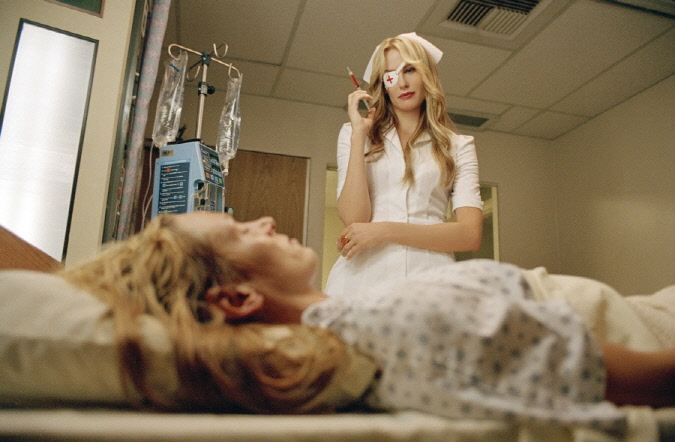
And that is nearly the whole story of the film, but Tarantino’s screenplay plays us like piano in one way or another. While its non-linear narrative often takes its time for delving a bit into the personality of the Bride and several other main characters in the story, each of the sequences in the film are peppered with dialogues as fun and engaging as you can expect from Tarantino. Most of them are quite talky to say the least, but they bring more spirit and personality to the story and characters, and that is one of the main reasons why we remain constantly interested for more than 4 hours.
In addition, it is often fun to observe the references to all those countless old B movies cherished by Tarantino with all his heart For example, he immortalizes the whistling theme for “Twisted Nerves” (1968) by Bernard Herrmann during the dexterous sequence where one of Bill’s assassins is approaching to the unconscious body of the Bride with a lethal purpose, and that is just the beginning of many things for us to notice one by one.
Above all, the movie entertains us with several striking action sequences packed with brutal violence. The climactic part of the first half of the film is particularly gory and bloody as our heroine, whose bright yellow attire will surely remind you of that final film of Bruce Lee, relentlessly slashes and stabs a bunch of goons with her very, very, very, sharp Japanese sword provided by the master swordsmith played by Sony Chiba, but, thanks to Tarantino’s skillful direction, we get a lot of fun and excitement even though we wince more than once for good reasons. Sure, lots of people get killed or maimed in the film, but, just like those John Wick flicks, the movie handles its many brutal moments of violence with enough wit, style, and detail. As a matter of fact, we do not mind when it tries a bit of Japanese animation film for a more striking depiction of blood and violence early in the story.
Instead of trying to surpass the sheer violence and excitement of the first half of his film, Tarantino deliberately dials down himself a bit during the second half of the movie, which brings some substance to the bold style of the first half. While it is pulpy and violent as before, but the movie comes to show a bit of gravitas as our heroine approaches closer to her final target, and there is some surprise in what is eventually exchanged between them (No, it is not her real name or what she tragically lost at that time).
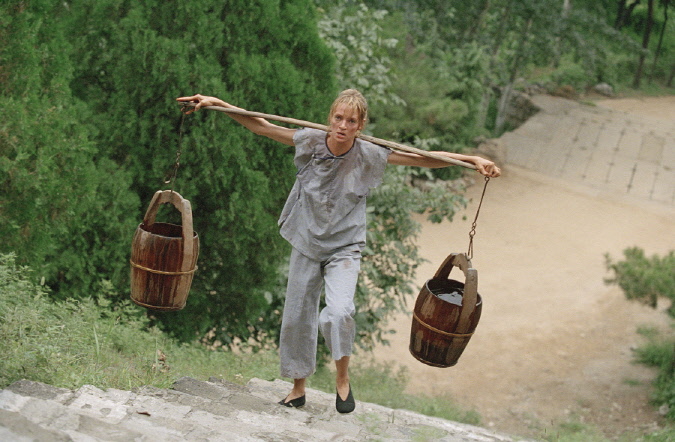
Everything in the film depends a lot on the presence and talent of Uma Thurman, who gives one of the best performances in her acting career. While looking totally serious as required, she is absolutely fearless as throwing herself into many moments of action in the film, and she also does a commendable job of balancing her broad but striking character well between humor and drama. Yes, the Bride is basically as ridiculous and outrageous as John Wick, but she has more life and personality compared to him thanks to Thurman and her director, and we come to care more about her eventual confrontation with Bill in the end.
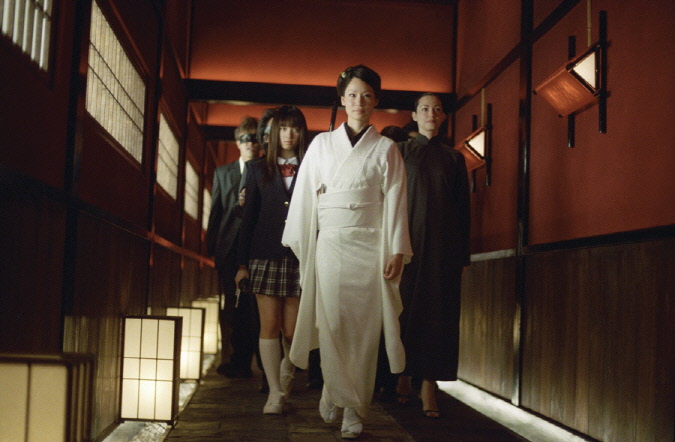
The movie is also filled with vivid supporting characters to enjoy, and all of them are embodied well by its wonderful supporting performers. Lucy Liu, Vivica A. Fox, Michael Madson, and Darryl Hannah are all memorable as those several assassins associated with Bill, and David Carradine does not disappoint us when his character finally reveals himself more during the second half of the film. Julie Dreyfus, Gordon Liu, and Michael Parks are also effective in their substantial roles, and Samuel L. Jackson briefly appears at one point in the middle of the story.
On the whole, “Kill Bill: The Whole Bloody Affair” is a bit too long besides being excessive at times, but its bold style and abundant spirit compensate for that a lot, I was constantly entertained from the beginning to the end. In my inconsequential opinion, Tarantino has often been pretty disagreeable as a person or a cinephile especially during last several years, but he gave us “Pulp Fiction” (1994) and several other unforgettable masterworks including this one, and I respect that at least despite my growing reservation on him.


 Seongyong's Private Place