
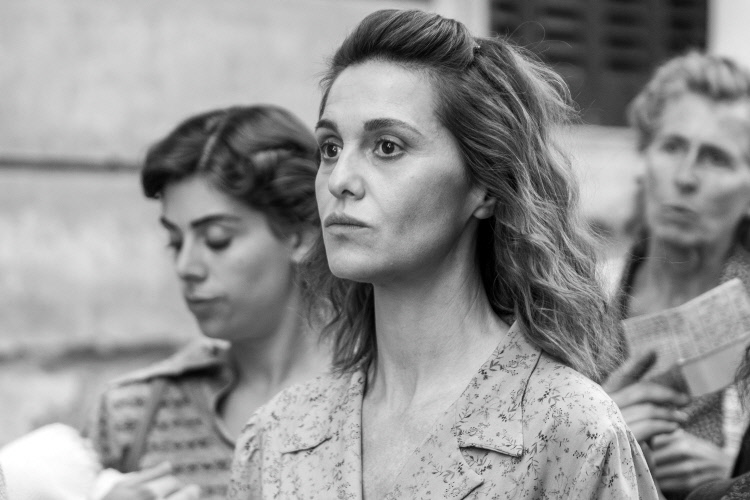
Italian film “There’s Still Tomorrow” is a little but pleasant mix of old and new stuffs to be appreciated. Although this seemingly modest female movie may feel quite typical in terms of story and characters, the movie cheerfully swings back and forth between humor and comedy as effectively delivering its feminist ideas and messages, and you may also often be amused a bit by how it boldly mixes some stylish modern elements into its shabby period background.
The story is mainly set in a neighborhood of Rome in May 1946, which is not long after the end of World War II. Just like many other people in the city, Delia (Paola Cortellesi) and her family have struggled a lot to earn their living day by day, and the opening part of the movie observes how Delia supports her family via several different menial jobs to be done here and there around the city.
However, Delia’s diligent daily efforts are not appreciated much by her family. Her husband Ivano (Valerio Mastandrea) has frequently abused and insulted her without showing any gratitude at all, and we are not so surprised when this deplorable prick shows more of his toxic masculinity when he later has a little private conversation with his ailing father, who also frequently disregards Delia without any consideration. In case of her eldest daughter Marcella (Romana Maggiora Vergano), she is mostly occupied with getting closer to her boyfriend, and Delia’s two younger sons are often nothing but a trouble to her.
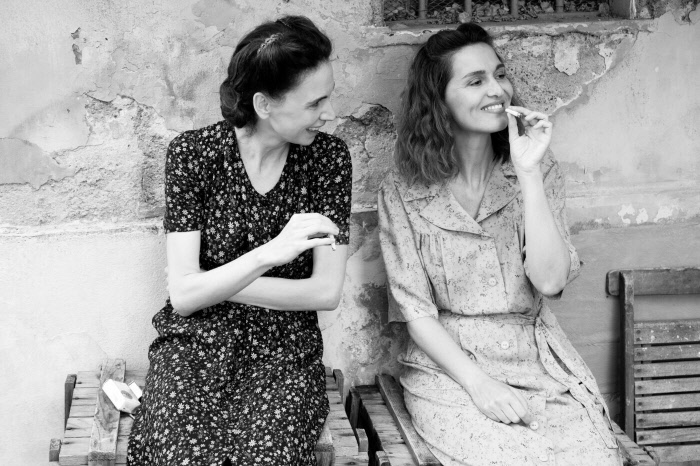
While she is not someone easily daunted by all the pain and misery inflicted upon her day by day, Delia frankly admits later in the story that she had no choice but to go on from the very beginning. As an uneducated Catholic woman, leaving her husband is out of question for her – even when her old sweetheart, who has considered leaving for somewhere for a better life sooner or later, indirectly suggests that she can leave with him right now if she really wants. Besides, she still clings to the old memories from when she and her husband actually loved each other a lot, and this makes his frequent abuse a bit more bearable for her.
However, she comes to notice more of the gender inequality which has blocked her in one way or another. At a local umbrella shop where she has worked as a part-time employee, she notices that she is paid much less than a new male employee even though she has to teach and guide him right from the basic level. She naturally protests, but, of course, her employee, who is your average sexist male just like many other men in Delia’s world, does not listen to her at all.
And we sense more of the sexism and gender inequality around Delia and many other women in the city. Although the female citizens of Italy were finally allowed to vote during the upcoming national election, women are still regarded like second-rate citizens under their patriarchy system, and we cannot help but become more concerned along with Delia when her daughter is about to marry her boyfriend. Right from the meeting between the two families, it is clear that her daughter is merely regarded as a living property by Ivano and the parents of Marcella’s boyfriend, and we are not so surprised when Delia’s worst fear turns out to be very correct.
Nevertheless, the movie does not lose any of its lightweight sense of humor even when things become quite grim for its heroine. During one particular moment of domestic violence between Delia and her husband, their violent physical interactions are suddenly turned into a series of dance moves, and the score by Lele Marchitelli also becomes a bit jazzy to our little surprise. This is surely jarring at first, but the movie somehow finds the right balance between stylized humor and the dark horror behind this striking scene.
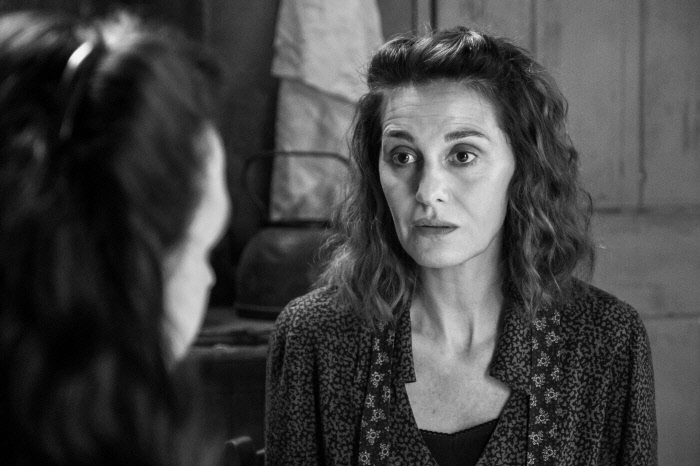
And that is just one of many bold touches in the film. Shot on black and white film, the movie certainly evokes those classic Italian neorealism films during the 1940-50s at times, but director/co-writer Paola Cortellesi, who also plays the heroine of her movie, deliberately inserts modern pop songs into several key scenes. This musical choice may feels merely anachronistic at first, but it comes to reflect more of the indomitable spirit inside Delia, and we come to root for her more when she eventually begins to come out of her resigned attitude.
Although the main characters in the film are more or less than broad archetypes, they come to us as distinctive figures to remember thanks to the engaging performance from Cortellesi and her fellow cast members. While Cortellesi steadily holds the center with considerable presence and dignity, several other cast members including Valerio Mastandrea, Romana Maggiora Vergano, Emanuela Fanelli, and Giorgio Colangeli are effectively cast in their respective supporting roles, and Vergano and Cortellesi are particularly effective when their characters come to have a brief but meaningful argument later in the story.
In conclusion, “There’s Still Tomorrow”, which is incidentally Cortellesi’s first feature film, is a solid female film packed with enough emotional power to make us overlook most of its several weak aspect (The subplot involved with an American soldier who shows Delia a lot more kindness and compassion than expected is a bit too contrived, for example), and it does earn its expected feel-good finale. Yes, things still need to change more for her and many others even at the end of the story, but she now experiences much more freedom and independence than before, and we all know that she will not step back at all no matter what will happen next.


 Seongyong's Private Place