
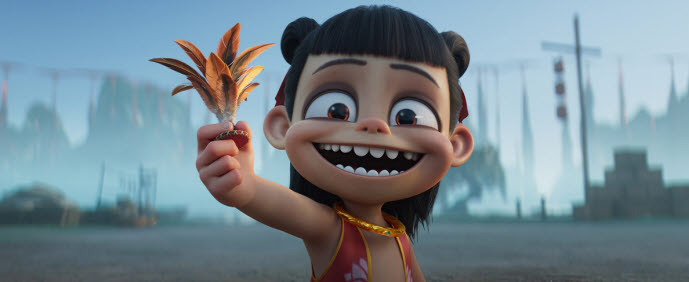
Chinese animation film “Ne Zha 2”, the sequel to “Ne Zha” (2019), strives to be bigger, longer, and better, but it ends up only accomplishing its first two tasks to my dissatisfaction. Thanks to its much more production budget, it surely provides a lot of big and spectacular moments to behold, but, folks, I hardly cared about the story and characters during my viewing.
In my review on the 2019 predecessor, I admitted that I enjoyed its silly but lightweight comic moments associated with its little naughty hero, who still reminds me of that satanic kid from “The Omen” (1976). I somehow found him rather endearing nonetheless, and I cared about the conflict involved with his true identity. In fact, this is the main reason why the film held my attention for a while before resorting to a lot of loud and busy actions during its expected climactic part.
Right from its beginning, “Ne Zha 2” swiftly throws us into more actions to follow. Although they managed to save the day at the end of the first film, Ne Zha (voiced by Lü Yanting) and Au Bing (voiced by Han Mo) are technically dead as their respective bodies were consequently destroyed, and Ne Zha’s master Taiyi Zhenren (voiced by Zhang Jiaming) and Ne Zha’s parents, who are incidentally the chieftain and chieftess of their town, try their best for restoring the respective bodies of Ne Zha and Au Bing.
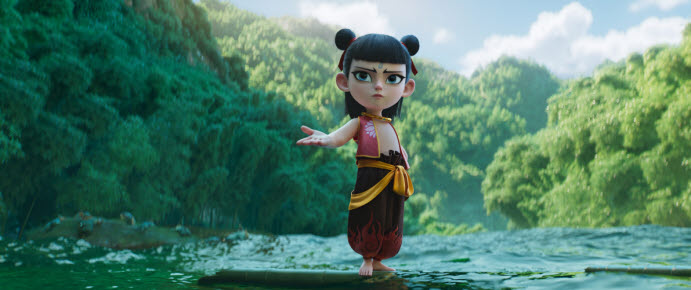
However, things soon become all the more serious once Au Bing’s mighty dragon father comes to learn about what happened to his dear son. He ordered Au Bing’s former master Shen Gongbao (voiced by Yang Wei) to attack Ne Zha’s town along with a heap of demons under his supervision, and he is also assisted to considerable degree by a trio of other powerful dragons, who all seem willing to help him but look quite treacherous to say the least.
Anyway, Shen, who turns out to be more sensible and compassionate than expected, soon suspends the attack once he sees what Taiyi has been trying to do for Au Bing, but there is one big problem. For completely bringing back Au Bing to life, a certain special kind of elixir must be obtained from the heaven, and Ne Zha must go through a series of challenging tasks under Taiyi’s guidance.
Needless to say, Ne Zha must hide his true nature as much as possible, and that is where Au Bing, who currently remains as a spirit in contrast to his best friend, comes handy. Despite being without his physical body at present, Au Bing can still exert his power while being inside Ne Zha’s body, besides being able to function as Ne Zha’s cover. Needless to say, he and Ne Zha must learn how to inhabit Ne Zha’s body together, and that leads to a silly moment of slapstick comedy which may take you back to Carl Reiner’s classic comedy film “All of Me” (1984).
When Ne Zha, who is now with Au Bing’s spirit who can take control of his body whenever Ne Zha is asleep, and Taiyi arrive at the palace of Heaven, the film naturally serves us with a lot of grand and beautiful moments to behold, though it occasionally shows a bit of naughtiness as Ne Zha quickly becomes your average fish-out-of-water. There is a little amusing scene involved with urination, and then there comes a deliberately gross moment when Ne Zha must go through the first test along with Au Bing inside his body.
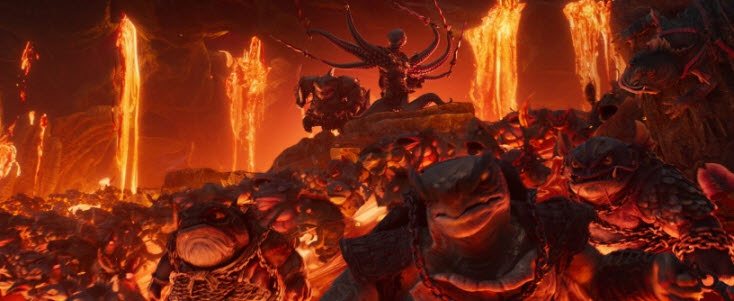
Meanwhile, the story gradually becomes more complicated with some additional main characters including Master Wuliang (voiced by Wang Deshun), who is ready to wield his own mighty authority on behalf of his more powerful master despite his avuncular appearance. While we also get to know a bit more about Shen’s personal life, the film also pays some attention to an emerging intrigue associated with the associates of Au Bing’s dragon father, who simply wants to get back his son above all else.
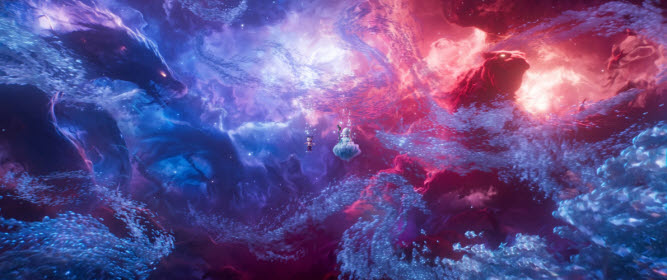
However, the screenplay by director/writer Jiaozi, which is a loose adaptation of the 16th-century novel “Investiture of the Gods” by Xu Zhonglin, fails to bring more depth to the story and characters. As it hurriedly drives itself toward its expected grand finale, the story simply goes up and down along with its main characters without clarifying much of what exactly motivates them, and several plot turns during its last act are not as effective as intended. In the end, we come to watch the following visual spectacles from the distance without much care, while also being more aware of its many superficial aspects.
At least, the film is not entirely without fun and entertainment. Several humorous scenes between Ne Zha and Taiyi give us some good laughs, though they remind us more of how flatly serious the scenes between Ne Zha and Au Bing are in contrast. When Ne Zha eventually reveals his true form and power (Is this a spoiler?) during the finale, the mood becomes all the more serious and ponderous instead of being really fun and exciting, but the film diligently supplies more spectacles coupled with a bit of surprise.
On the whole, “Ne Zha” does not go further than its predecessor besides being a bit too long in its running time (144 minutes). Considering what is shown in the middle of its end credits as well as its enormous commercial success around the world (It is incidentally the highest-grossing film of last year, by the way), there will surely be another sequel sooner or later, and I can only hope that I will be more entertained in the next time.


 Seongyong's Private Place