
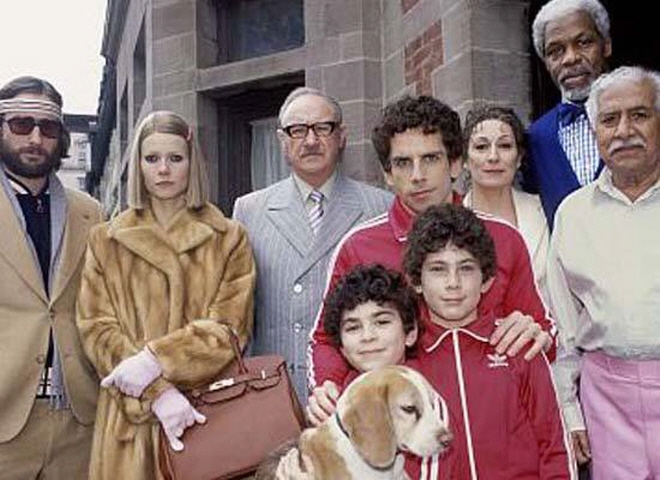
Revisiting Wes Anderson’s 2001 film “The Royal Tenenbaums”, I was reminded again of how consistent Anderson has been during last several decades. While this movie and many subsequent works of his are basically his own little dollhouse plays, they are all packaged with an ample amount of distinctive style and personality, and most of them are actually very funny and touching behind their frequently unflappable appearance.
“The Royal Tenenbaums” was incidentally Anderson’s third feature film, which came after “Bottle Rocket” (1996) and “Rushmore” (1998). While these first two feature films of his are more or less than a warm-up exercise because he still needed to hone his own idiosyncratic style and sensibility more at that time, “The Royal Tenenbaums” shows Anderson taking the first real big step at last, and it has almost everything to define a Wes Anderson movie.
The story, whose amusing narrative frame will be evolved further in Anderson’s subsequent films including “The Grand Budapest Hotel” (2014) and “Asteroid City” (2023), revolves around one dysfunctional family living in New York City. Although they were once promising bright kids wholeheartedly nurtured by their caring mother Etheline Tenenbaum (Anjelica Huston), Chas (Ben Stiller), Margot (Gwyneth Paltrow), and Eli (Owen Wilson) were damaged in one way or another by their selfish and insensitive father Royal (Gene Hackman), and we are not so surprised when his wife eventually decides that enough is enough and then kicks him out of their family house.
After more than 15 years passed, Etheline begins to consider having a divorce at last as finding herself falling in love with her accountant Henry Sherman (Danny Glover), and that is not a very good news for Royal. In addition to being on the verge of going totally broke, he recently gets kicked out of an expensive hotel room where he has resided for years, and he certainly needs to depend on Etheline more than ever.
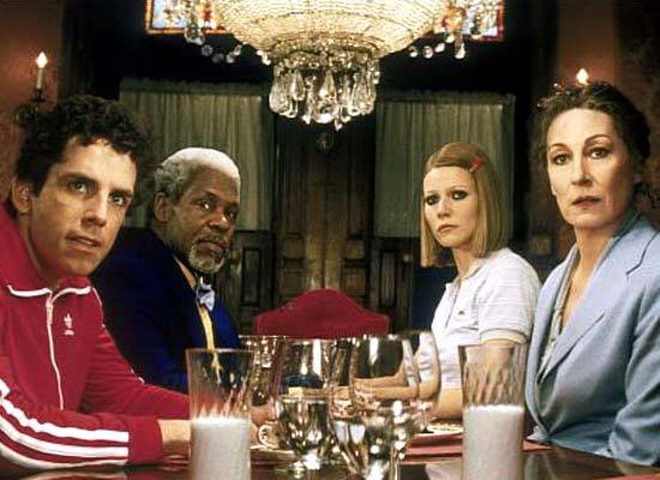
For getting more sympathy from his wife and kids, Royal impertinently lies to them that he is going to die sooner or later. Chas, who is still very resentful about what a bad father Royal was to him in the past, strongly objects along with Margot, who is not so amused to see her father again for the same reason (He has always reminded her that she was adopted, which becomes a sort of running gag throughout the film). In contrast, Eli, who still cares about Royal despite having his own fair share of disappointment with his father, insists that they should give their father another chance, and Etheline eventually agrees to let her husband return to their family house.
Needless to say, Royal is quite a pathetic figure, but we also observe more of how his kids have equally been pathetic as your typical cases of arrested development. While he was a little but brilliant businessman during his childhood, Chas becomes a neurotic man who has been quite fastidious about the safety of his two sons after his wife’s tragic death. While she distinguished herself as a child playwright, Margot is now going nowhere as being stuck with her psychiatrist husband who shows more passion in analyzing his latest case. While he was also quite famous as a tennis prodigy, Eli is now coasting on his retirement life without any plan or direction, and it later turns out that he has actually yearned for getting closer to Margot.
Now this surely looks like your average dysfunctional family story, but the movie distinguishes itself a lot from many other similar films via its sheer wit and style. Quite formal in its narrative structure, the screenplay by Anderson and his co-writer Owen Wilson, who is incidentally Luke Wilson’s older brother and also plays one of the main characters in the film, doles out unexpected quirky moments along the plot, and they are all the more amusing for the deadpan attitudes of the main characters. Regardless of how much they are aware of the absurdities of their comic situations, many of them remain flatly unflappable except a few sudden moments of emotional outbursts, which make a striking contrast with the phlegmatic overall tone of the movie.
At the same time, there are also the underlying pain and pathos around their deadpan comedy, and they prevent the film from becoming merely whimsical. Not so surprisingly, Royal comes to face more of how much he ruined his kids’ childhood, but there is not much he really can do about his damaged relationship with them, and he knows that too well – especially after his deception is eventually exposed later in the story (Is this a spoiler?). In case of his children, they still have to deal with how their respective lives got ruined by not only their father but also themselves, and the most harrowing moment in the film comes from when Eli feels quite betrayed and devastated after learning more about what Margot has been hiding behind her back.
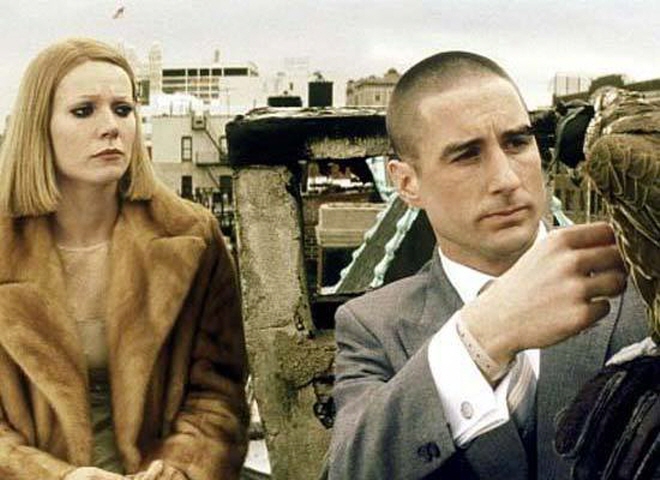
Nevertheless, the movie keeps maintaining its lightweight tone before eventually arriving at the finale where it strikes the right balance between humor and poignancy, and it is supported well by its well-rounded ensemble performance. While Ben Stiller, Gwyneth Paltrow, and Luke Wilson ably bring enough life and personality to their sibling characters, Anjelica Huston and Danny Glover provide some necessary gravitas as required, and Bill Murray, Owen Wilson, and Kumar Pallana, who often steals the show as a longtime family employee, flawlessly slip into their respective supporting parts.
In case of Gene Hackman, who sadly passed away in last week, this legendary actor gives one of the rather rare comic performances in his long and illustrious career, and it is constantly entertaining to watch how he effortlessly tickles us while subtly illustrating his complicated character with nuances and details to be observed. Yes, Royal is indeed a bastard as his wife says at one point, but he is also somehow likable despite all those numerous human flaws of his, and Hackman did a fantastic job of fully embodying many human contradictions of his character without any misstep at all. In short, this is his last great performance, but the Academy Awards failed to nominate him at that time, and that was incidentally one of its biggest mistakes during last 30 years.
On the whole, “The Royal Tenenbaums” is still a milestone point in Anderson’s career besides being one of the finest moments in the distinguished career of a great American movie actor, and you will admire more of how Anderson has steadily gone his way during last 24 years. After finally getting an Oscar thanks to his Netflix short film “The Wonderful Story of Henry Sugar” (2023), he is already working on his next project, and I am sure that he will find more fun and amusement from his own rich genre territory.
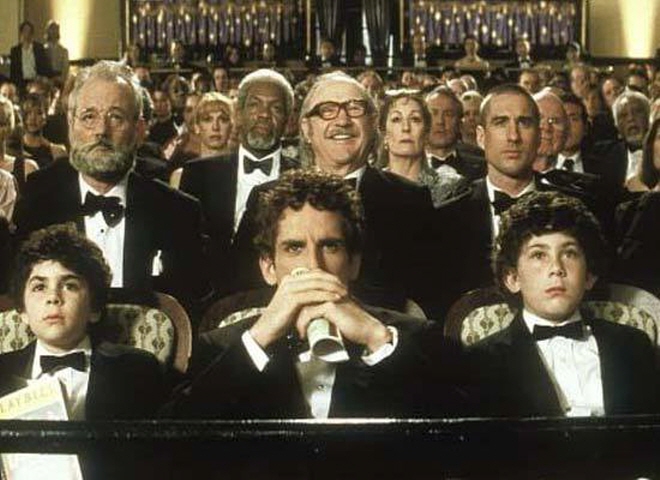


 Seongyong's Private Place