
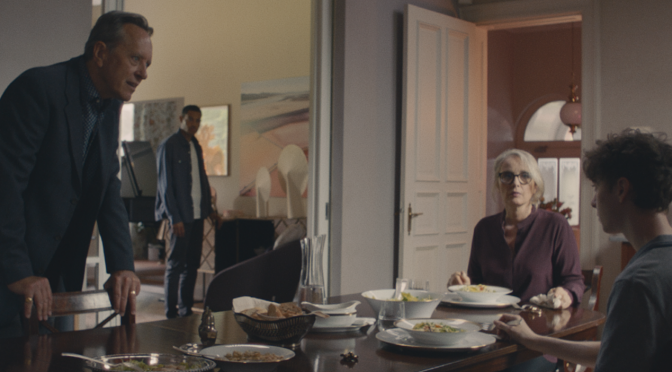
“The Lesson”, which is currently available on Netflix in South Korea, reminds me again of how it is usually difficult to make a movie about writers. Its main characters often talk about writing and literature throughout the story, and some literature excerpts are freely quoted from time to time, but I somehow never got the sense of any interesting plot or narrative thickening during my viewing.
Daryl McCormack, a promising actor who recently gave us a wonderful breakthrough performance in “Good Luck to You, Leo Grande” (2022), plays Liam Sommer, a young man who is in the middle of an interview on his sensational first novel during the prologue scene of the film. When his interviewer asks him a bit about his source of inspiration, Liam naturally makes some enigmatic smile, and it goes without saying that the movie is soon going to delve into how he came to write his novel.
The main story of the film, which incidentally consists of three parts, begins with Liam suddenly getting employed as the new tutor of the younger son of J.M. Sinclair, a successful novelist who has been acclaimed for a number of serious novels written by him. As an aspiring young writer who has also been a big fan of Sinclair’s books, Liam is certainly excited about this unexpected golden opportunity, and he does not mind at all about spending several days inside Sinclair’s isolated country house under the non-disclosure agreement with Sinclair.

Not long after his arrival in Sinclair’s house, Liam meets Sinclair’s younger son Bertie, whom he is going to put through a series of dense lessons before Bertie has a demanding college entrance interview at the English literature department of Oxford University. At first, Bertie seems merely pressured about this, but he also does not look like really caring about whether he will study in Oxford or not, and his father is actually more excited about his son’s potential as a writer.
Eager to listen and learn from his favorite author, Liam also cannot help but notice more of the considerable emotional gap between Sinclair and his two family members. Bertie does not like being compared to his older brother who tragically died not so long ago, but his father keeps comparing him to his older brother nonetheless, and that certainly exasperates Bertie a lot. In case of Sinclair’s French art collector/broker wife Hélène (Julie Delpy), she is often elusively cold and phlegmatic, and it is apparent that there is not much love or affection between her and her husband.
It is not much of a spoiler to tell you that Liam soon finds himself getting more associated with his favorite writer than his student. Sinclair later turns out to be struggling a lot with finishing a new novel of his, and Liam is certainly willing to help his idol as much as possible in exchange for getting some helpful criticism on his current work in process.
Of course, it does not take much time for Liam to realize that there is something really sneaky about Sinclair. While he frequently talks about writing and literature, Sinclair does not seem to be that productive at all in his current writing process, and Liam also comes to suspect more about the recent death of Sinclair’s older son, who was incidentally quite a promising writer just like Bertie is at present.

What is eventually revealed along the story will not surprise you much, because the screenplay by Alex MacKeith virtually spelled that out in advance. In addition, it also fails to develop its few main characters into believable human characters to interest and then engage us. Liam is your average colorless hero who mostly observes everything from the distance, and he is only distinguished a bit by his exceptional photographic memory. Sinclair and his family members are more or less than stereotype caricatures, and you may be instead interested more in whether Liam’s eventually published novel has actually developed them more into three-dimensional characters. After all, literature is supposed to sublimate that superficial third-rate novel called reality, right?
As a result, we could not care that much about what is going on in the story while sometimes admiring how much McCormack and his fellow cast members in the film try to make their characters work as much as possible. Despite mostly stuck in his rather thankless role, McCormack acquits himself well on the whole, and Richard E. Grant, who has always been good at playing smarmy characters as shown from his recent Oscar-nominated supporting turn in “Can You Ever Forgive Me?” (2018), surely has some juicy moments as his character’s pompous façade gets crumbled later in the story. Although it is nice to see Julie Delpy trying something different from her usually likable appearance, the movie sadly does not provide much substance for her efforts, and she ultimately gets wasted just like Stephen McMillan, who unfortunately does not have much to do except usually looking morbid and sullen as required.
On the whole, “The Lesson”, directed by Alice Troughton, is not entirely without fun mainly thanks to its good cast members’ diligent efforts, but it will not tell or show you anything substantial about creative writing while leaving some empty impression on you in the end. If you actually expect to learn anything about creative writing from the movie, just go back to William Strunk Jr. and E. B. White’s guidebook “The Element of Style” or Stephen King’s equally valuable book “On Writing”. Believe me, you will have a much more productive time there.


 Seongyong's Private Place