
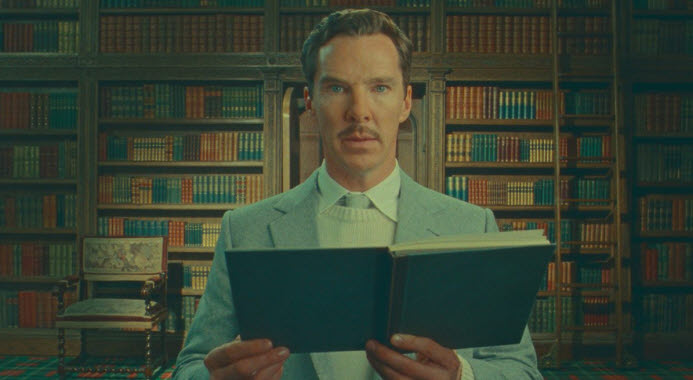
Wes Anderson’s short film “The Wonderful Story of Henry Sugar”, which was premiered at the Venice International Film Festival early in this month and then was released on Netflix on this Wednesday as the first of a four-part series of shorts adapted from Roald Dahl’s short stories, is a little but undeniably charming piece of work which will surely delight any fan of Anderson’s films out there. While this is another typically mannered work of his, Anderson, who previously adapted Dahl’s children book “Fantastic Mr. Fox” for his 2009 stop-motion animation feature film, fills the film with an ample of amount of wit and style as expected, and it is certainly the terrific starting point for the rest of the series to come after it (“The Swan” and “The Ratcatcher” are already released while “Poison” will come tomorrow, by the way).
Like Anderson’s recent works such as “The Grand Budapest Hotel” (2014) and “The French Dispatch” (2021), the film is rather complex in its overall narrative structure. At first, we are introduced to Dahl played by Ralph Fiennes, and then the movie delves into the story of a British dude named Henry Sugar (Benedict Cumberbatch), which is incidentally associated with an unbelievable tale involved with an old Indian guy who happened to develop an uncanny ability to see things without using his eyes at all.
If you are not so familiar with Dahl’s original short story, I will simply let you delighted by how the story of the film effortlessly hops from one point to another – and how Anderson and his crew members including his longtime cinematographer Robert Yeoman superbly handle the mood and details on the screen. As usual, Yeoman’s camera observes the characters and backgrounds from distantly static positions, and the scene composition is as precise and meticulous as you can expect from Anderson, but Anderson and Yeoman sometimes break away from their usual mode deliberately. For example, when that old Indian Man, played by Ben Kingsley, demonstrates his special ability in front of the two doctors played by Dev Patel and Richard Ayoade, the camera quickly follows after Kingsley’s character at one point, and the result is dramatically effective while never disrupting the detached overall mood of the film.

Via Kingsley’s character, the mood becomes as colorful as Anderon’s previous film “The Darjeeling Limited” (2007). As Kingsley’s character enters a remote jungle area where a certain great yogi guru has lived alone, the film ably shuffles several different backgrounds for our delight and entertainment, and what is eventually exchanged between Kingsley’s character and that yogi guru character is another amusing moment for us.
The film engages us more as Cumberbatch’s titular character later tries to test himself after accidentally encountering a written record left by Patel’s doctor character. Because he is an affluent guy who does not have much to do in his comfortable daily life, Sugar is eager to focus on developing any potential inside him, and, what do you know, his little experiment turns out to be much more successful than he imagined.
The last act of the film is initially fun to watch as Sugar tests himself with more confidence, but then there comes Dahl’s usual last-minute twist. Sugar is surely excited about his newly regained ability at first, but, not so surprisingly, he becomes rather depressed about his remarkable success, and that reminds me of the ironic dilemma inside being the master of the universe. If you can correctly know and predict everything in the universe, that may be pretty awesome to you for a while, but then you may also be dreadfully crushed by the absolute absence of uncertainty in everything including your death.

While sharply recognizing the absurd irony of Sugar’s circumstance, the film pulls out a surprisingly sweet final moment which will grow on your mind after it is over, and that reminds me again of how many of Anderson’s best works have considerable emotional qualities behind their dryly detached attitude. Although I was not totally enthusiastic when I watched his latest feature film “Asteroid City” (2023) a few months ago, I still could sense the melancholic feelings lingering around the screen, and that is the main reason why I admire it to some degree even though I still do not think it is one of his better works.
Anderson assembles a much fewer number of performers here than before, but it is evident that he still has lots of fun with handling them as his usual deadpan dolls to play in front of the camera. While Benedict Cumberbatch demonstrates a more humorous side of his intense talent, Ralph Fiennes and Ben Kingsley are constantly compelling even though they are demanded to deliver their lines as flatly as possible just like many of Wes Anderson movie performers. In case of Dev Patel and Richard Ayoade, they also find each own source of humor just like their fellow main cast members, and I sincerely hope that they will work for Anderson again someday.
As I said before, I initially regarded Anderson’s films as a sort of acquired taste, but I gradually changed my opinion as getting more accustomed to his films, and he has been one of my favorite filmmakers during last several years. “The Wonderful Story of Henry Sugar” is surely a quintessential Wes Anderson film, but it also shows Anderson trying something different in his usual artistic territory, and I am glad to report here that he accomplishes as much as intended while impressing us again.


 Seongyong's Private Place
Pingback: 10 movies of 2023 – and more: Part 2 | Seongyong's Private Place