

French documentary film “The Velvet Queen” is often awe-inspiring whenever it calmly and meditatively observes all those wide and beautiful landscapes of one mountainous area of Tibet. Closely following one tenacious attempt to document a certain rare local animal species on camera, the documentary vividly presents the sheer wonder of nature and wildlife on the screen, and that is more than enough to compensate for its several notable shortcomings.
The documentary mainly revolves around a prominent nature photographer named Vincent Munier, who incidentally directed the documentary with Marie Amiguet, and Sylvain Tesson, a writer who later wrote a book about their little joint quest for documenting the snow leopard inhabiting in that mountainous area of Tibet. Because this animal species has been quite elusive even for seasoned professionals like Munier for many years, Munier is quite determined to accomplish this seemingly impossible task from the beginning, and Tesson is willing to follow and observe Munier’s efforts to the end even though he is not that experienced in comparison.
Of course, Munier and Tesson must wait and search for many days without any promise on eventual success, and we see how they must often be patient and careful in their ambitious mission. First, they must find any suitable spot where they may find a snow leopard, and then they should hide themselves as much as possible without drawing any attention because snow leopard is quite cautious and watchful to say the least.
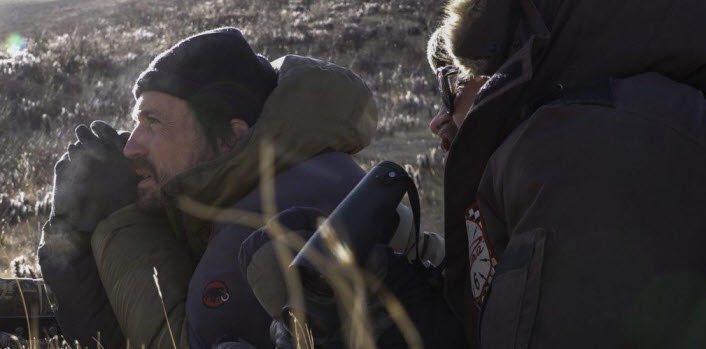
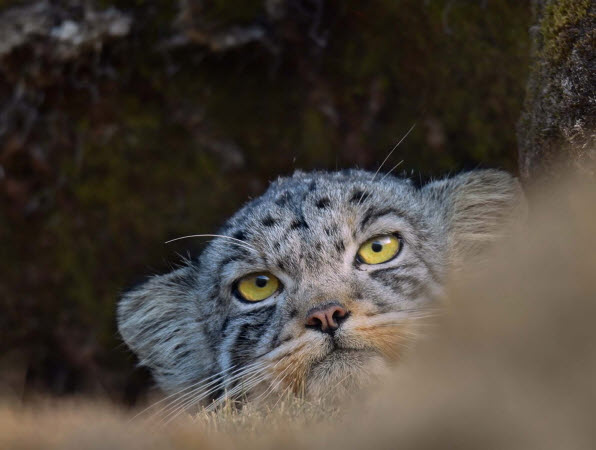
As they keep waiting for any chance to capture snow leopard on their camera, the documentary often looks around the nature environment and the wildlife inside it. Even in this cold and harsh environment, many different species have flourished for many years without any interference from our human world, and Munier and Amiguet, who also serve as the cinematographers of the documentary along with Léo-Pol Jacquot, did a splendid job of filling the screen with a considerable sense of awe and wonder. While there are a number of truly stunning landscapes shots to behold, there are also a bunch of wonderful shots of numerous wildlife animals to amaze you, and I particularly like one scene later in the documentary where Munier and Tesson explore a big cave which has been apparently inhabited by one animal species after another. Each of these certain animal species left behind its own trace inside the cave, and that makes the cave looks like a sort of natural history museum.
In contrast, the human parts of the documentary are not so interesting in my humble opinion. Via his ubiquitous narration throughout the documentary, Tesson reflects a lot on not only nature and the humanity but also his life and career, but, despite his sincere and serious attitude, his narration often sounds like the audiobook version of your average self-discovery book, and I must confess that my mind often got distracted instead of attentively listening to his words. In case of Munier, he sometimes muses on how much he feels comfortable and peaceful outside the human world, but, folks, that is what we usually hear from many other professional wildlife photographers out there.
That is probably why my attention was often drawn to a few other human figures at the fringe of Munier and Tesson’s narrative. When the opening scene shows two local guys who are also trying to photograph wildlife animals, I got interested in getting to know them more, but, to my little disappointment, the documentary does not delve much into who they are. In case of one substantial scene involved with a local family, we get some amusement as observing Tesson’s clumsy interaction with a little young boy, but that is all we can observe, and I wish the documentary paid more attention to these local people.

Anyway, Munier and Tesson’s pursuit of snow leopard still engages us as their cameras continue to capture one wonderful moment of nature after another. At one point, the documentary shows us one of Munier’s old photographs which happens to have a little glimpse of a snow leopard by accident, and that makes us more interested in whether they will succeed in the end. Once they find a spot where snow leopard may pass by, they plant a small camera at that spot for the constant monitoring, and it later shows them more of how many animals pass by that spot every day and night.
What eventually occurs in front of their camera is presented well with enough dramatic effect, and this brief but crucial moment is further enhanced by the sparse but undeniably effective score by Nick Cave and Warren Ellis. As a matter of fact, I wonder whether the documentary would be more effective if it were simply accompanied with Cave and Ellis’ score instead of frequently depending on Tesson’s rather redundant narration.
In conclusion, “The Velvet Queen”, which won the César Award for Best Documentary in France early in last year, is not entirely without weak aspects, but its strong aspects will linger on your mind for a long time after you watch it. Sure, we cannot complete dissociate ourselves from our human civilization as busily living day by day, but we sometimes need to be slowed down for more reflection on ourselves and our life on the Earth, and the documentary certainly reminds me of how important that really is.


 Seongyong's Private Place